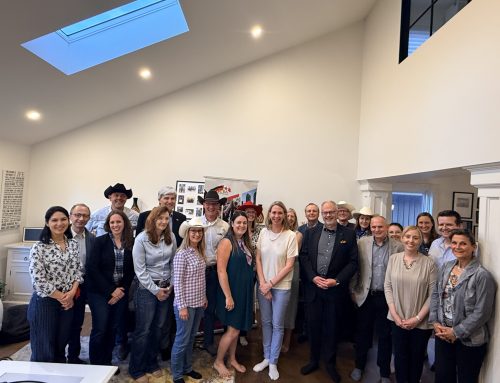
The German-Canadian Business Association recently partnered with the French Chamber of Commerce and Industry in Canada for a joint event at Metro Vino in Calgary. Bringing together members of the German and French business communities, the evening combined professional exchange with an in depth look at the business case and provincial regulatory frameworks surrounding the import of European wines into Canada. Guests also had the opportunity to learn directly from the Metro Vino team about their business, sourcing approach, and expertise in European wines. A highlight of the evening was a blind tasting featuring French and German wines, encouraging participants to move beyond preconceptions and explore the diverse wine regions of both countries.
The event created valuable opportunities for professionals and businesses with European roots who are expanding into the Canadian and Alberta markets while navigating many of the same opportunities and challenges. Through discussions with the Metro Vino team including the owner Richard Harvey, guests also gained practical insights into the complexities of importing European wines into Canada, including regulatory requirements, taxation, distribution systems, and provincial liquor board frameworks.
Metro Vino further showcased its exceptional expertise in German wines, offering what is the largest selection of German wines in Alberta, if not Western Canada. Their team regularly travels to Europe to personally source wines from small, privately owned German wineries, creating a unique portfolio with many wines not available anywhere else in Canada.
One particularly interesting takeaway from the evening was Alberta’s flat-tax system on wine import, which can make premium wines notably more affordable compared to provinces with percentage-based taxation systems, while entry level wines are often comparatively more expensive as a result.
Representing the organizations were François Xavier Jeannet, Board Director Alberta for the French Chamber of Commerce and Industry in Canada, and Alexandra Liebrecht, Director Alberta of the German Canadian Business Association. The evening also welcomed a strong group of GCBA members and community representatives, including Deborah Marinoske of Activate Future, former Honorary Consul of Germany Hubertus Liebrecht, Nicole Schaefer of Spiegelbild Inc., ProCanada Consulting Inc., Lindsay Luhnau of the Calgary Winter Market, Harald Kelly of the German Canadian Club of Calgary, and Jana Husmann.
The event reflected the shared commitment of both organizations to fostering values-based business relationships across borders, professional exchange, and collaboration within Alberta’s European business community.
-

- Professor Antweiler delivered a great comparison of EV adoption in Canada vs. in Germany

-

- We are thankful for a great turnout

-
- Deputy Consul General Mr. Jakobi delivered opening remarks